

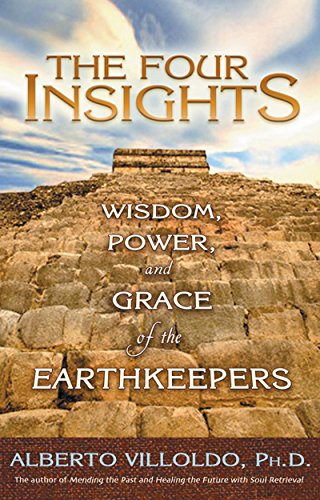
If I were to sum up this book in one word… or number… it would be 2012. Remember? That one year when we all should have died because some ancient Mayan calendar predicted that natural catastrophes would devastate our way of life? Whether or not people actually believed the hype, there was a subtle sense of urgency that year for people to live out their lives “just in case.” I’m pretty sure that was around the time YOLO popped up which, now that I think about it, doesn’t seem like such a coincidence. I think some of us wanted to believe that ancient cultures contained a kind of greater spiritual wisdom that was lost in the transition to our logic-based societies, despite its implications for our survival.
Alberto Villoldo did an excellent job at grabbing my attention along those lines. For some background information, he was a professor at San Francisco State University by his mid 20’s and was conducting research investigating how energy medicine and visualization could change the chemistry of the brain. He realized that only studying neural networks could not illuminate the whole picture, so he decided to drop everything and travel through the Amazon and Peru to learn from medicine men. The fact that he had a Ph.D. suggested he wasn’t a complete loon, so I wanted to see what a scholar from modern society learned after 10 years of training under the keepers of that ancient wisdom.
Right from the beginning I realized that I would need to set aside virtually all of my preconceived notions of how anything works to see his point of view… So yeah, a lot of the stuff he talked about was pretty far out there. Chakras, energy fields surrounding the body, evolution of a new species of humanity, time as non-linear: concepts that would cause a lot of people to put the book down immediately and condemn it as New Age bullshit.
Despite a lot of the content, I was continuously drawn further and further into the book because of how level-headed his writing style was. It was as if he had no desire to fluff up or sell his ideas to the audience; he let the audience determine their worth. He simply spoke his truth based on his own personal experiences with surprising clarity and precision.
I’m not going to try explaining a lot of what the book goes into because of its metaphysical nature, but one of the main concepts can be useful regardless. The foundation of the book is based on four different levels of perceiving and acting in the world. We have the ability to access these levels at any time, but the higher levels encompass the levels before them and are therefore more difficult to attain. The next four paragraphs detail each of the four levels.
Serpent: Deals with the body and physical perception. It encompasses our senses and many of our instincts that function without regard to mental or emotional states.
Jaguar: Deals with the mind and emotional perception. Any rational thoughts, feelings, or beliefs we hold falls into this category. This is the level we normally function on as we make decisions and communicate.
Hummingbird: Deals with the soul. It encompasses a mythic nature of our existence where we experience ourselves on a spiritual journey. Music, poetry, and mythic stories function on this level, where creations do not arise solely from the mind. Instead of thinking in terms of everyday life, it involves thinking metaphorically in terms of an all-encompassing personal picture.
Eagle: Deals with the spirit. It views all of matter and life as energy manifesting itself in different forms. Everything is connected.
“When you shift your perception to a higher level, you can transform the myriad challenges you’re facing in your emotional and physical worlds. You can understand that what you perceive as a problem in one sphere is actually an opportunity at the level above it.”
Mastering these four perceptions involves understanding that what we normally perceive is a projection of what is going on within. By healing these ills and transforming the parts of us that we often choose to deny, we have the opportunity to manifest actual changes in the world for the better.
Overall, the book makes a lot of bold claims that sound appealing, but would require a leap of faith to genuinely believe. If anything, it was an interesting read that provides a potential explanation for our place in the world and how we can affect the trajectory of our existence. Perception is key.
 wonderwithin.me
Leave a comment