

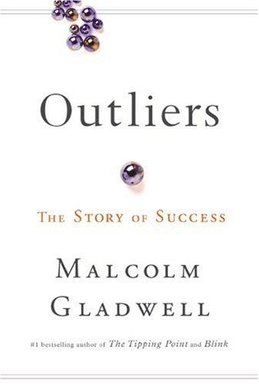
For the past couple years, I must admit my interest in Malcolm Gladwell’s books has been entirely superficial. Whenever I would enter into bookstores I would always steal a passing glance at his books thinking maybe today I will finally read one. Sometimes when I was in the right mood I would even pick one up, caress the pages a bit (the edges were oh so flush against my fingertips), maybe nod approvingly after staring at its backside, but always resort to leaving it for someone else’s compulsions.
That is, until a close friend of mine recommended that I should actually read one. It’s been long enough, and even though he didn’t know about my history with Malcolm books I think he could somehow sense my urge. It was about time to engage in some nice, literary intimacy (if you know what I mean).
Overall, the book is about how a person’s success is not only the result of some special characteristic of the individual, but rather a complex combination of other factors including environment, culture, and circumstance. Sounds a bit straight forward, but I must assure you that Malcolm’s ability to tell engaging stories with striking insights was nothing short of titillating.
Part 1: Opportunity
This part can be best explained by the nature vs nurture debate, which questions whether a child’s genetics or upbringing mostly determines how they turn out. While Malcolm discusses mostly the nurture side, however, he pushes the boundaries of what that normally encompasses by including opportunity.
Take competitive hockey as an example. Kids often start off at very young ages, and by watching them play it becomes obvious that some are a bit better than others. They may be more coordinated, faster, stronger, bigger; in general they are more adapted to play the game. Often times this is seen as “natural talent,” which results in these kids getting special treatment to facilitate that talent. They play in more rigorous leagues, get more practice, and more exposure to the game overall. Eventually, this extra practice and competition adds up and they have a good shot at competitive hockey further down the line.
Strangely enough, a psychologist named Roger Barnsley noticed a pattern by observing the rosters of various professional hockey teams in Canada. It wasn’t related to their height, weight, or year they were born in; those are too easy to recognize. It was instead related to the month they were born in. An overwhelming number of the players were born in either January, February, or March, and the numbers decreased in the following months. Why does that matter?
Opportunity actually plays a significant role. It turns out the eligibility cutoff for age-class hockey in Canada is January 1. As a result, the kids in any given class could be up to 11 months apart, which is a huge benefit during crucial years of development. Their coordination, speed, strength, and size that made them better at the sport might just be because they were older. That small difference early on then had the ability to snowball through additional practice and support, which resulted in the difference between an exceptional player and an average player. Just imagine what that could mean for education!
“It’s outlandish that our arbitrary choice of cutoff dates is causing these long-lasting effects, and no one seems to care about them.”
Part 2: Legacy
This part explores the implications of traditions and attitudes we inherit from our forebears and how they affect our relation with the world in unexpected ways. He gives a couple examples, but what fascinated me was his explanation for a series of plane crashes that were all from one company: Korean Air.
For the sake of keeping this post short, I’m not going to go into all of the details that led to his conclusion. In all honesty, I know I’m not doing this book justice by summarizing the main points and a few examples (I could say that about any book but its especially true for this book), but I’ll do my best to try. For the full experience, I highly recommend reading this book in its entirety!
In the end, he explains it using one of Hofstede’s Dimensions called the “Power Distance Index” (PDI). Hofstede’s Dimensions are various categories that seek to rate the psychology of different cultures, and the PDI is an indicator of a culture’s attitude toward hierarchy. This is a broad category that includes respect for elders, special privileges for people higher up in the hierarchy, and communication between classes. Korea, along with Mexico and the Philippines, are among the countries with the highest PDI.
This translates to higher levels of respect for authority and mitigated communication. In the example Malcolm examines, the second in command of the plane understood something was wrong, but telling the captain in an authoritative manner would be disrespectful. It was up to the captain to determine the reality of the situation and properly interpret the suggestions of the second in command. Speaking with the captain and air traffic control in a manner that did not accurately reflect their dire situation greatly contributed to miscommunication and the eventual crashing of the plane. Their culture influenced their actions, and while having a high PDI is not necessarily a bad thing it is simply not as effective in this kind of situation.
The book examines various other interesting topics such as Bill Gates, the Beatles, Asian success in math, and IQ. Overall, it was an enjoyable combination of anecdotes with surprising insights and supporting evidence. I tried my best to share the book with you, but there is much more to it than ideas and examples. Turns out you really can’t judge a book by its cover (or a blog post for that matter).
 wonderwithin.me
Leave a comment