

*Disclaimer: In reading this blog post you are assuming personal responsibility for your frame of mind. In the event you are searching for a reason to be angry, support for your political views, or feelings of superiority over me or others then I highly recommend you do not venture any further. This post is intended for the purposes of knowledge and open mindedness that will allow you to make informed decisions in any aspect of your life. In other words, to expand your box just a wee bit.
With that in mind, what is anarchism? In my mind I see bad ass guns, motorcycles, tattoos, and the commercial to the FX television show Sons of Anarchy. Although I’ve never actually watched that show, a quick Wikipedia search about the series 1 overview paints a pretty intense picture starring drug addiction, threats of murder, and I’ll just say “creative” uses of the bible. Simply stated, anarchy = chaos; or so I thought.
In reality, anarchism is as much a philosophical stance grounded in rights of the people as it is a lifestyle. Freedom constitutes it’s core, but that doesn’t help to define it much either. That, in my mind, has been reduced to a disgusting stew of hippy lovin, ‘Murica, and “would you like room for cream in your coffee?” Anarchism and freedom have roots extending far and wide, making a cohesive ideology of either pretty much impossible to create.
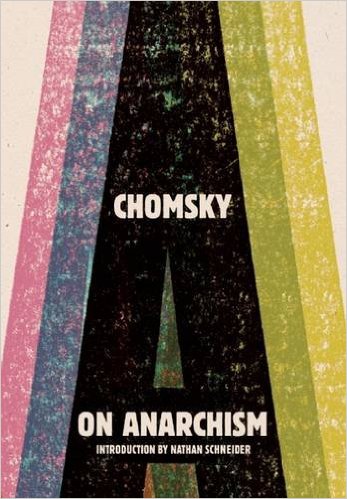
To help give it a more solid foundation, Noam Chomsky explores it from an intellectual perspective. He was a popular professor of linguistics at MIT that has written extensively on topics ranging from economics to philosophy to mass media. To get a broad overview from the start, he uses the quote shown below.
“For the anarchist, freedom is not an abstract philosophical concept, but the vital concrete possibility for every human being to bring to full development all the powers, capacities, and talents with which nature has endowed him, and turn them to social account.” – Rudolf Rocker
Therein lies a key distinction that he makes throughout the book between US libertarianism and anarchism. For the sake of brevity I’ll just talk about one underlying foundation of both: limited governmental control.
Libertarians generally want unbridled freedom for the sake of the individual as long as he/she does not harm others. This ties in with conservative ideals of free market capitalism and private ownership that seeks to unleash the individual and essentially disconnect him/her from others. The quote taken from their official party platform online sums it up pretty well.
“As Libertarians, we seek a world of liberty; a world in which all individuals are sovereign over their own lives and no one is forced to sacrifice his or her values for the benefit of others.”
Anarchists, on the other hand, are more aligned with leftist ideals of socialism. They advocate control over the means of production by the workers in service of the community. Working with and for others in the name of cooperation is embedded in its structure. It works against involuntary control, whether that is in the form of government or unbridled capitalism. An example of involuntary control by unbridled capitalism would be wage slaves in factories. Yes they have the free choice to work at the factory, but the number and quality of options is vastly limited by their economic status.
“The core of the anarchist tradition, as I understand it, is that power is always illegitimate, unless it proves itself to be legitimate. So the burden of proof is always on those who claim that some authoritarian hierarchic relation is legitimate. If they can’t prove it, then it should be dismantled.”
To achieve Chomsky’s view of an anarchist and truly free society, he highlights the need to first solve what he refers to as the “animal problem” of scarcity. A person cannot truly be free if his basic needs are not met. This would involve universal access to water, food, shelter, and other basic necessities for survival. In the past this was out of the question because of our methods of production, but in our current technological society he believes it would be entirely possible and indeed necessary.
After that has been established, then we can start to learn different forms of community through experience. He purposefully does not try to construct a utopian society because we simply do not have enough evidence about how to bring that about. We have a shitload of theories, but a society for analysis that he is proposing is not readily available. He looks to examples of anarchist ideals such as the kibbutzim in Israel and the Spanish Civil War, but we are still far from fully exploring the possibilities. In other words, solving the “animal problem” will just allow us to start addressing the “human problem” of living well and facilitating the virtues of all people.
“A vision of a future social order is in turn based on a concept of human nature. If in fact man is an indefinitely malleable, completely plastic being, with no innate structures of mind and no intrinsic needs of a cultural or social character, then he is a fit subject for the “shaping of behavior” by the state authority, the corporate manager, the technocrat, or the central committee. Those with some confidence in the human species will hope this is not so and will try to determine the intrinsic human characteristics that provide the framework for intellectual development, the growth of moral consciousness, cultural achievement, and participation in a free community.”
 wonderwithin.me
Leave a comment