

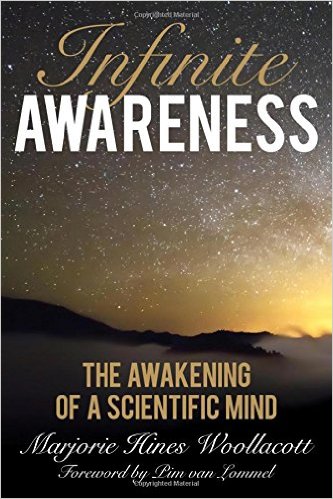
For the past few hours, I’ve been freaking staring at this blog post trying to figure out the best way to present the information in this book. I’ve hashed out paragraph upon paragraph talking about stuff ranging from boxes to Weird Al to mind-blowing inspiration, but everything seems to fall short of what this book actually represents.
At it’s core, it addresses a question that I’ve been asking myself for years, and I know I’m not alone in that endeavor. A level above that, it is an inspiring story that weaves together the author’s personal experiences, scientific investigations, and spiritual practices into a unified and robust theory. And finally, it is a call to action to push past the frontiers of our own understandings. We currently live in a sea of information that is often difficult to navigate, but this book taps into the knowledge of what we actually are.
As a neuroscience professor at the University of Oregon, Woollacott started her journey with a widely held notion of what the brain is. It is an extremely important organ that regulates and controls almost everything about us. Emotions, language, heart rate, movement, sight, smell… The insane complexity behind the 100 billion neurons that constantly fire in our brains to handle all of this information is beyond words. Arguably, our brains make us who we are.
Science has taken great strides in our understanding of the brain despite the magnitude of its awesomeness. We have mapped various regions of the brain and understand their functions through rigorous experimentation. Since we can reasonably predict a good portion of its activity, many neuroscientists have concluded that the brain is essentially a machine that produces consciousness. We don’t fully understand it yet, but it is only a matter of time before we do. The book The Future of the Mind by Michio Kaku that I discussed a while ago was a testament to that belief.
As a theory, it is practically bulletproof. Woollacott probably would have taken it with her to the grave like many others before her, but her sister had something else in mind. She convinced Woollacott to attend a meditation retreat, and without going into the flashy details she had a singular experience that catalyzed a major shift in her pursuits and her understanding of consciousness. She could not explain it using her current model, so she took on the spirit of a scientific investigator and examined other phenomena that also did not fit in order to construct a new one.
To give you a full taste of what the book is about, I found this article online about a near death experience from the perspective of another neuroscientist. I highly recommend that you read it, and if you do please read it all the way through. If you can get past the seemingly cheesy parts and the obvious religious hints, I can bring it back to the everyday world that Woollacott and the rest of us are traversing.
That is just one of many phenomena she examines that all hint at an underlying truth. She presents compelling evidence for the reality of near death experiences, the placebo effect, neuroplasticity, reincarnation, hypnosis, intentionality of healers, and of course quantum mechanics. It is fucking mind blowing.
The underlying theory that links all of this together is that consciousness is fundamental in the universe. If that sounds esoteric, it’s because it is. She explains it in a lot of different ways, but the one that made the most sense to me was the idea of the bottom-up versus top-down perspective.
Bottom-up is how science normally views the world and it aligns with the idea of the brain I outlined earlier. Essentially, everything we perceive can be reduced to fundamental forces and matter, and more complex things arise out of them. For example, our complicated experience of consciousness can be reduced to the firing of neurons, which function with electricity. The brain produces consciousness.
Top-down, however, flips that script on its head. Instead, consciousness is fundamental and interacts with the brain in a different way. Instead of a generator, the brain is more like a filter that channels consciousness into a distinct person. It is a compelling theory that highlights the interconnected yet distinct nature of everything we can imagine. Woollacott lays it out from a scientific perspective, but it is a spiritual teaching as old as human history.
“To experience thinking outside the brain is to enter a world of instantaneous connections that make ordinary thinking seem like some hopelessly sleepy and plodding event.”
Of course this understanding doesn’t mean that the external world just disappears. It does, however, allow you to dive headfirst into the frontiers of this different understanding of consciousness. However you look at it, by nature of being alive you are a conscious being. We missed the opportunity to explore new lands, and we are still pretty far away from colonizing Mars. In the meantime, why not try to experience and learn about what you are?
 wonderwithin.me
Leave a comment