

“Thinking about the present as if it were the past.”
That’s it. That’s pretty much the entirety of this book packed into one quote. No need to really summarize anything or even discuss it for that matter. Done. Moving on.
… But if that’s it then why did I actually enjoy this book? I felt disappointed and even cheated out of my money because I didn’t feel I learned anything, but why is it bad that I didn’t? It’s probably because of my insatiable desire to learn and improve myself. Is that good? What if, in the future, ambition is seen solely as an outlet for selfishness that is destructive to sustaining a functioning community? Is that bad? Maybe this book is a reminder to take a step back and appreciate the present instead of chasing after something.
Or is it the opposite? Did this book just lull me into a sense of cheap happiness because it was disorienting? It pretty much stuck my brain into a bouncy house with 9-year-old kids playing tag. I was thrown around with a ton of different perspectives about how to relate to events from the past and how to think now with the future in mind. In the midst of all the potentials swirling around it was impossible to move. The mind of a skeptic can be paralyzing, but why is it so enjoyable? Did I just spend hours masturbating mentally when I could have used that time for something useful? When I could have been engaged in life and made a difference in something?
To give you a sense of what I mean, I’ll try my best to engage you in Chuck’s exploration of gravity. With the exception of physicists, most people have the general concepts of gravity pinned to a law about the universe. It is an attractive force that increases with the mass of an object. The earth is pretty massive (but not really compared to pretty much anything else in the universe), and causes objects to accelerate toward its surface at 9.81 m/s2. You don’t need to question much to realize that gravity is real. Newton was a genius for figuring it out scientifically, blah blah blah.
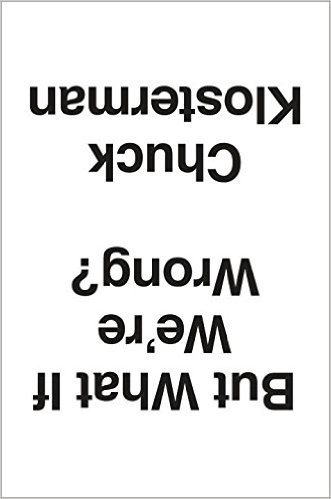
But what if we’re wrong? Fundamental facts about the universe we thought were unquestionable have changed many times throughout history. The earth is not flat, and light acts like both a particle and a wave. If our understanding of such an unquestionable concept changes, it has the potential to affect the understanding of nearly everything else.
Some scientists are trying to work up more inclusive theories about the universe that reconcile Newtonian and Quantum physics, but that’s beside the point. What if gravity was much less concrete than we think? Before Newton, the prevailing idea about why objects fall back to earth was proposed by Aristotle. He believed rocks belonged on earth and craved their “natural place.” With that as the prevailing view, imagine how crazy Newton would have sounded when he explained that an invisible, imperceptible force field somehow anchors the moon in place and also causes apples to fall. The moon and the earth somehow communicate with each other.
With Einstein, our view of gravity as just a force changed also. Now, it is the result of a warping of time and space. Uneven distributions of mass and energy result in a curvature in spacetime, which relates to the relative malleability of space and time. This keeps going down the rabbit hole, but since Chuck is not a scientist he just ends it with another question: what if our laws of physics were no longer explained with space and time as its basis, but with something more fundamental?
The book is also filled with other topics that are easier to relate to such as professional football, rock music, the Declaration of Independence, and TV shows. At the core of all his engaging, interesting explorations is his attempt to illuminate the idea of naive realism. We believe our views of the world are stable and real, despite the fact that everything in the past hints at the idea that we are probably completely wrong. It was a fun book at the end of the day, and to get you interested in reading the book I want you to think about this old Greek proverb:
“The clever fox knows many things, but the old hedgehog knows one big thing.”

 wonderwithin.me
Leave a reply to History Unfolding – Wonder Within Cancel reply